How does SGP.32 fit into the GSMA Remote SIM Provisioning evolution, and what benefits does it offer for the global enterprise?
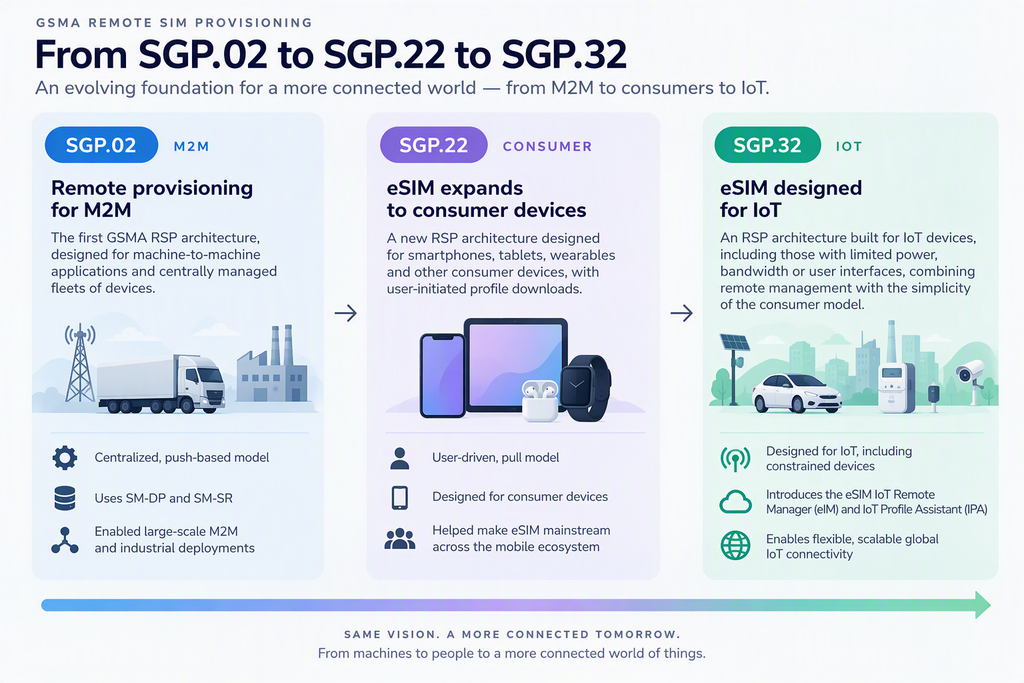
SGP.32 is the GSMA Remote SIM Provisioning specification designed specifically for IoT. It builds on two earlier approaches: SGP.02 for machine-to-machine (M2M) applications and SGP.22 for consumer devices.
For enterprises deploying connected products globally, SGP.32 is an important step forward. It enables operator profiles to be remotely provisioned and managed on IoT devices, including devices with limited power, bandwidth or user interfaces. This can make global connectivity more flexible, scalable and easier to manage throughout a product’s lifetime.
What is Remote SIM Provisioning?
Remote SIM Provisioning (RSP) allows mobile network operator profiles to be securely downloaded and managed on an eUICC, commonly referred to as an eSIM.
With a traditional physical SIM, changing connectivity can require physical access to the device. With eSIM and RSP, connectivity profiles can instead be managed remotely.
This becomes particularly valuable in IoT. A manufacturer might have hundreds of thousands of connected vehicles, industrial machines, energy devices or tracking units operating across multiple countries. Physically replacing SIM cards in those devices is extremely costly and simply impractical.
RSP turns connectivity into something that can increasingly be managed through software.
SGP.02: Remote provisioning for M2M
SGP.02 established a Remote SIM Provisioning architecture for M2M applications.
It was designed for environments where large fleets of devices needed to be managed centrally, without requiring a user to interact with each device. The architecture uses components including the Subscription Manager Data Preparation (SM-DP) and Subscription Manager Secure Routing (SM-SR) to provision and manage eSIM profiles.
This approach helped establish remote management for applications such as automotive and industrial IoT.
But the M2M model also introduced complexity. Relationships and integrations between ecosystem participants could require significant technical and operational coordination. As IoT expanded into more industries and device categories, the market needed a simpler and more flexible approach.
SGP.22: eSIM expands to consumer devices
SGP.22 introduced an RSP architecture designed for consumer devices, including smartphones, tablets and wearables.
The consumer model differs from the M2M architecture. Instead of connectivity being managed entirely through a centrally controlled push model, SGP.22 introduced a model in which an eSIM profile can be downloaded to a device, typically with user involvement.
This architecture helped make eSIM familiar to millions of consumers.
But IoT presents a different challenge.
A smart meter, vehicle component or industrial sensor may have no screen, no camera and no person available to initiate a profile download. Devices may also have limited bandwidth, constrained power consumption or intermittent connectivity.
IoT therefore needed the flexibility of newer eSIM architectures while retaining the ability to remotely manage large fleets of unattended devices.
SGP.32: eSIM designed for IoT
SGP.32 addresses that requirement.
SGP.32 defines an RSP approach specifically designed for IoT devices, including network-constrained and user-interface-constrained devices.
Rather than simply extending the original M2M model, the IoT architecture builds on concepts established through the consumer RSP ecosystem.
Two important components are:
- eSIM IoT Remote Manager (eIM): supports the remote management of eSIM profiles across IoT devices.
- IoT Profile Assistant (IPA): provides functionality associated with managing profile operations on the device or eUICC.
The result is an architecture designed around a fundamental IoT requirement: devices need to be remotely manageable without assuming that a person is interacting with them.
What are the benefits of SGP.32 for global cellular connectivity?
SGP.32 becomes particularly valuable when connected products operate across multiple countries and networks.
1. Manufacture globally, connect locally
Connectivity choices no longer need to be tied as tightly to the point of manufacture.
A manufacturer can produce an eSIM-capable product and remotely provision appropriate connectivity later in the product lifecycle. That provides greater flexibility when the same product is manufactured centrally but distributed across many markets.
2. Change connectivity remotely
An operator profile can be provisioned and managed without replacing the physical SIM.
That matters when devices are difficult or expensive to access. Instead of treating the connectivity decision made during manufacturing as permanent, enterprises can have greater flexibility to adapt connectivity during the device’s operational life.
3. Simplify global IoT deployment
A connected product may ultimately operate across dozens of countries.
SGP.32 provides a standardized foundation for remote profile management across an ecosystem of device manufacturers, eSIM providers, connectivity providers and mobile network operators.
Standardization can make it easier to build scalable global connectivity models rather than creating country-specific hardware and SIM configurations.
4. Support constrained IoT devices
SGP.32 is specifically designed for IoT environments.
That distinction matters because many IoT devices have limited bandwidth, power or processing resources and may have no user interface at all. The specification enables these devices to participate in an eSIM ecosystem without requiring the consumer-style interactions associated with smartphones.
5. Create greater lifecycle flexibility
The connectivity requirements of a product can change during a deployment that lasts five, ten or even fifteen years.
Products move between countries. Network availability changes. Commercial agreements evolve. New connectivity requirements emerge.
The ability to remotely manage eSIM profiles gives enterprises more options for responding to those changes without physically modifying deployed devices.
Does SGP.32 replace SGP.02 and SGP.22?
Not exactly. RSM-based connectivity orchestration has been possible since the dawn of the standard.
SGP.02 was designed for remotely managed M2M deployments.
SGP.22 brought eSIM provisioning to consumer devices.
SGP.32 brings a new RSP architecture to IoT, combining remote fleet management with concepts developed through the consumer eSIM ecosystem.
In that sense, SGP.32 is best understood as the next stage in the evolution of Remote SIM Provisioning for IoT, rather than a replacement of the earlier specifications. The technology you choose is more than just a question of what’s the “latest and greatest”.
From eSIM management to connectivity orchestration
Historically, connectivity could become embedded into a product early in its design or manufacturing process. RSP creates a foundation for connectivity to be managed and adapted throughout the product lifecycle.
For global enterprises, this supports a fundamentally different model, and this is also where the potential of connectivity orchestration becomes increasingly clear.
SGP.32 provides a standardized eSIM foundation for IoT. A global connectivity platform can build on that foundation to orchestrate profiles, networks, commercial policies and operational requirements across countries and operators.
For KDDI Spherience, SGP.32 represents more than another eSIM specification. It is indeed an enabler of a more flexible global IoT ecosystem, where connectivity can evolve with business needs,, but more importantly, it brings the benefits of connectivity orchestration to a broader enterprise audience.